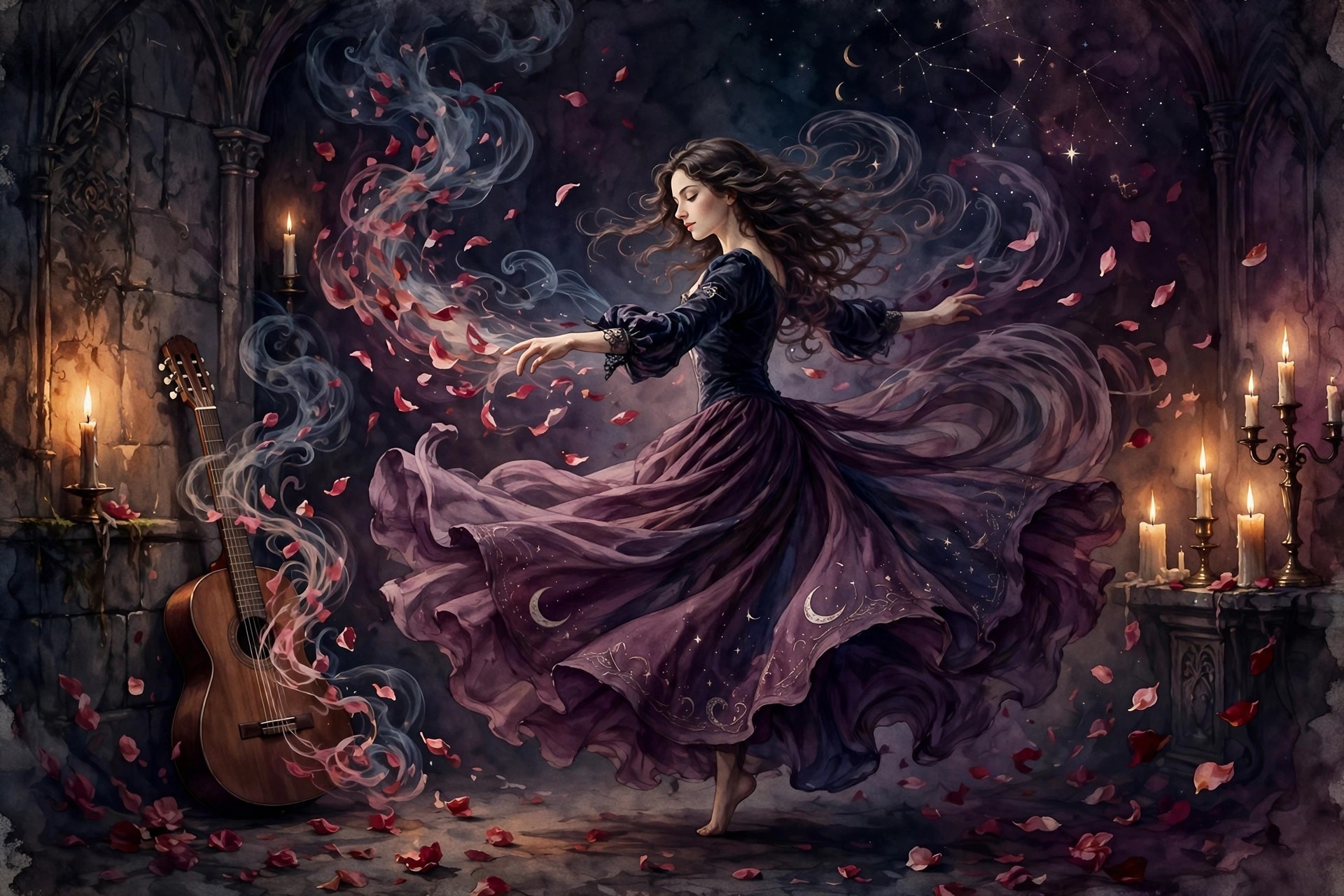
Bachata becomes more than music—it becomes memory carried through the body. Bachata of the Wound traces what it means to love inside a rhythm that has been passed down, wounded, and yet still offers a floor to stand on.
The guitar wails — not to be heard,
but to be held.
It trembles with the memory
of hands that knew the dark.

I learned to move
before I learned to speak.
My hips found the rhythm
of a home that was breaking.

Mami, you danced in the kitchen,
barefoot on cold tile,
your skirt a flag,
your heart a drum.

Papi, you sang with your eyes closed,
a voice like cracked sugar,
sweet enough to forgive,
sharp enough to stay.

The bachata was never just music.
It was the way we said
what we could not say,
the way we stayed.

The floor remembers every step,
every stumble,
every time we rose
to dance again.

There is a wound in the rhythm,
a pause where the heart breaks,
a silence that teaches
the body to listen.

I carry it in my shoulders,
in the sway of my hips,
in the way I hold
what I have lost.

The dance is not forgetting.
It is remembering
with the whole body,
with the whole heart.

When the music starts,
the room becomes a prayer.
The lights dim,
the shadows dance.

We are not broken,
we are bending.
We are not lost,
we are learning.

The guitar wails — not to be heard,
but to be held.
It trembles with the memory
of hands that knew the dark.

The song ends,
but the echo stays.
The floor is empty,
but the rhythm remains.

We leave the floor, not the same.
We leave the floor, not the same.
We leave the floor, not the same.
We leave the floor, not the same.
✦ Sit with it
What step did you learn by watching, not by being taught?
When has a song carried you back to someone you have lost — or to a version of yourself you thought was gone?
Where in your body do you still feel the waltz of the old songs — and what would it mean to dance them as your own?
We do not close the wound. We learn to move with it — gently, honestly, and in time. The guitar may wail, but the feet remember the way forward. The floor is still ours. The rhythm is still ours. The story is still ours.
Leave a Reply