A Reflection on Seeing
The Fluidity of Art: A Conversation Between Creator and Viewer
Art has long been a subject of debate—what makes something a masterpiece? Is it defined by skill, the cultural context in which it was created, or its ability to evoke emotion? Some argue that art requires a certain level of technical mastery, a structured approach that adheres to principles of composition, form, and execution. Others believe that art is an act of raw expression, unshaped by rules or expectations, existing purely to communicate something—anything—between the artist and the observer.
Yet, art is not merely what is created; it is also what is perceived. A work can carry deep personal significance for the creator but be lost on an audience. Alternatively, something seemingly mundane or accidental can stir profound thoughts and emotions in those who encounter it. This is the beauty and the paradox of art: it is both intentional and accidental, meaningful and meaningless, fixed and fluid—all at once.
John Berger opened Ways of Seeing with a sentence that rearranges everything that follows it: “Seeing comes before words” (Berger, 1972). Before we can describe a work, defend it, or dismiss it, we have already seen it — and what we saw was shaped by everything we brought into the room. The debate about masterpieces is never really about the object alone. It is about the collision between an object and a lifetime.
“It is both intentional and accidental, meaningful and meaningless, fixed and fluid—all at once.”
A Face in the Egg: When the Mind Finds Meaning
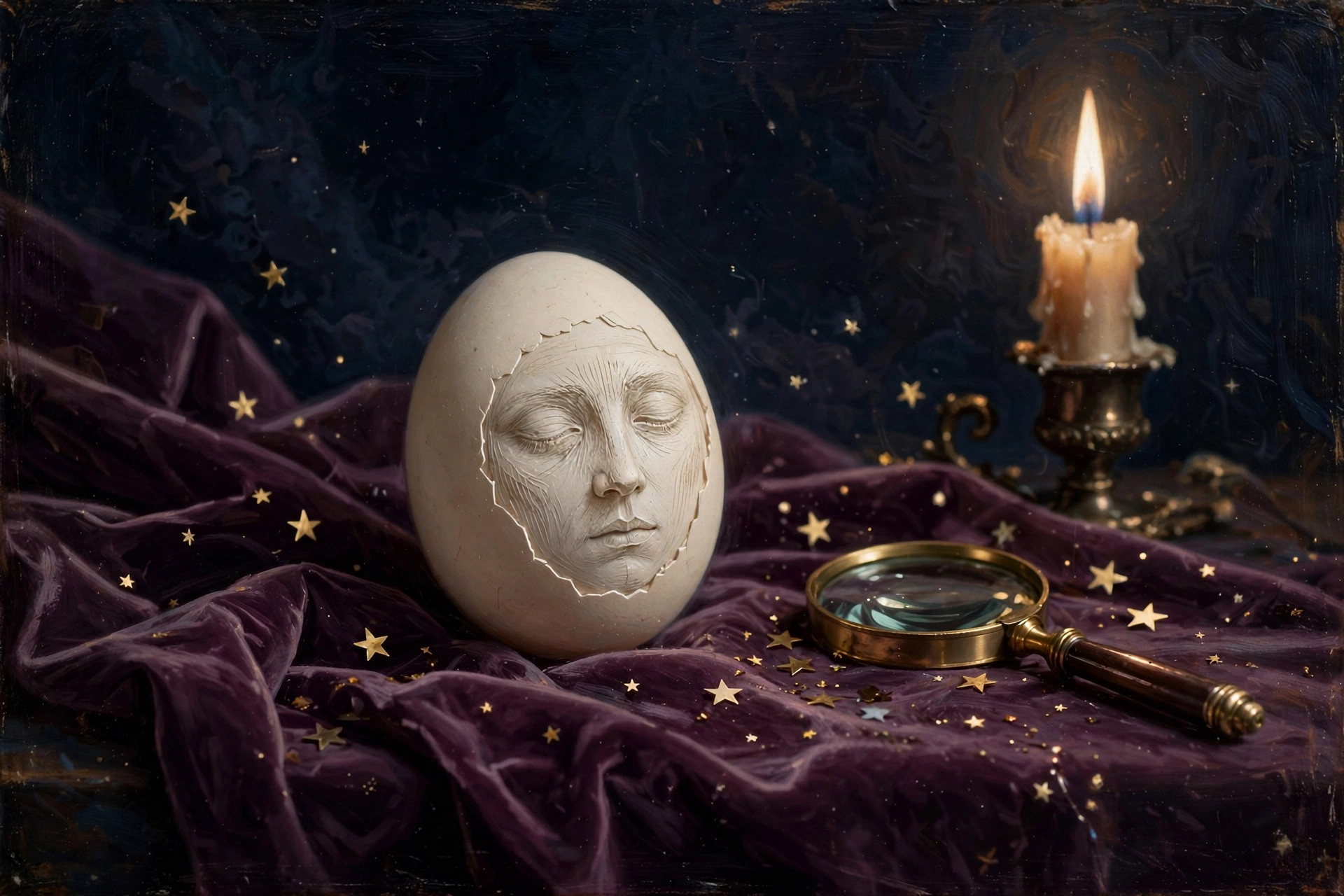
I recently encountered an image that, at first glance, appeared simple—an abstract carving of a face on an egg. There was no dramatic composition, no intricate detail, just a quiet, almost unsettling expression resting on the fragile surface of an egg. Yet, the longer I looked at it, the more it drew me in. There was something about the face—its stillness, its suggestion of thought—that made me pause. Was it meant to be a portrait? A symbol? Or just a shape that my mind instinctively tried to interpret as human?
At first, I wondered—was this intentional, or merely an accidental creation? Did the artist deliberately carve that face, or did I, the observer, project meaning onto it? This is a question that has lingered in art theory for centuries—what defines a work of art? Is it the intent of the creator, or the experience of the viewer? If an artist creates something without meaning, but a viewer finds profound significance in it, is it still art?
Psychology has a name for what my mind was doing: pareidolia, the brain’s reflex to find faces and patterns in random forms. It is the same reflex that puts a man in the moon and figures in the clouds, and it once fooled the whole world at planetary scale — in 1976, a NASA photograph of a Martian mesa looked so much like a monumental human face that it took higher-resolution images, decades later, to persuade everyone it had only ever been rock and shadow. The machinery that found a civilization on Mars is the machinery that found a soul on an eggshell. We do not passively receive the visual world. We interrogate it, and the first thing we always ask is: is anyone there?
✦
The Role of Interpretation: Why Meaning is Personal
Art is not just about what is presented; it is about how it is received. Every viewer brings their own history, emotions, and perspectives to a work. The same image can evoke vastly different responses depending on who is looking at it. For one person, a face carved on an egg might symbolize fragility and the weight of existence. For another, it could be nothing more than an unusual decorative object.
This fluidity of meaning is what makes art so powerful. It mirrors our own thoughts, emotions, and lived experiences. It is not a fixed object with a singular interpretation—it is an evolving dialogue between the artist, the work, and the audience.
Consider how people react differently to modern and abstract art. Some dismiss minimalist paintings as simplistic, while others see them as profound expressions of emotion. The work itself has not changed, but the way we engage with it has. Meaning is not embedded in the object alone—it is shaped by the mind of the beholder.
Oscar Wilde saw this coming over a century ago. In the preface to The Picture of Dorian Gray, he wrote: “It is the spectator, and not life, that art really mirrors” (Wilde, 1891). Stand in front of Mark Rothko’s great hovering rectangles and you can watch Wilde’s sentence prove itself in real time: one visitor shrugs at “two blurry boxes,” while the person beside them is quietly weeping, because those fields of color have somehow become the exact shape of their grief. The painting did not change between the two viewers. The beholders did. Rothko understood the exchange so well that the chapel built around his final canvases in Houston is treated less like a gallery than a place of worship — fourteen dark paintings, and whatever you carry in becomes the fifteenth.
✦
Does Art Require Meaning?
This leads to another important question: does art need to have meaning? If a piece is created purely for its aesthetic appeal, does that make it any less valuable? Traditional art theory often ties art to intention—a work must have a purpose, a message, a voice. But what if the power of art lies not in its intended message, but in its ability to evoke something in the viewer—even something the artist never anticipated?
Looking at the egg-carved face, I found myself caught between these two perspectives. Did the artist intend for this to be a face at all? And if not, does it matter? The human brain is wired to find patterns, to see faces in clouds, shapes in shadows, and meaning in the abstract. Perhaps the most profound art is not the kind that tells us what to think, but the kind that invites us to see—to question, to interpret, to feel.
In the end, I realized that meaning is not confined to the artist’s intent. Sometimes, the most compelling works are those that exist in a space of ambiguity, where interpretation is left to the observer. The face on the egg was more than a carving; it was an invitation to explore perception, to ask what it means to recognize something human in the unexpected.
In 1917, Marcel Duchamp submitted a porcelain urinal, signed “R. Mutt” and titled Fountain, to an art exhibition — an object he had not made, carrying no message he would explain. The exhibition hid it behind a screen. A century later, it is considered one of the most influential artworks of the twentieth century, not because of anything Duchamp’s hands did to it, but because of the question it forced every viewer to answer for themselves. Duchamp spent the rest of his life insisting on the viewer’s share of the work: “The creative act is not performed by the artist alone,” he said; the spectator completes it (Duchamp, 1957). The urinal and the egg sit at opposite ends of art — one chosen to provoke, one carved in quiet — and they arrive at the same place. Meaning is a collaboration, whether the artist planned the meeting or not.
“The act of engaging, questioning, and feeling is what makes something art.”
✦
The Ever-Shifting Nature of Artistic Value
Art is not static—it shifts with culture, personal experience, and perspective. What moves us today might not move us tomorrow. A piece that feels insignificant at first glance can, over time, reveal layers of meaning we were not ready to see. This unpredictability is what makes art so alive. It evolves with us.
The carved egg-face, however simple, served as a reminder that art is not always grandiose or meticulously crafted. Sometimes, it is in the unexpected, in the strange and unsettling, that we find the most thought-provoking expressions. The act of engaging, questioning, and feeling is what makes something art.
History keeps the receipts for this. The Mona Lisa hung in the Louvre for centuries as a respected portrait — admired, but one masterpiece among many — until the morning in 1911 when it was stolen off the wall. Crowds queued to stare at the empty space where it had been; the theft made headlines around the world; and when the painting came home two years later, it returned as the most famous image on earth. The paint had not changed. We had. Value is not only a property of objects. It is an event that happens between an object and its moment — which is why the work you walked past at twenty can stop you in your tracks at forty, and why no honest viewer can ever promise that what leaves them cold today will not undo them later.
The Beholder I Bring With Me
All of this is doubly true for those of us whose inner weather is louder than most. A mind that feels intensely does not look at art neutrally; it looks hungrily. It finds the face in the egg because it is practiced at searching surfaces for feeling. It stands longer in front of the dark painting because it recognizes the climate. This is not a distortion of the work — it is one of the oldest functions art has: to take an interior landscape that cannot be said plainly, and give it a shape that can be seen, by the maker first and then by anyone who has lived in similar weather. The poems and images that stay with us are rarely the ones that explain themselves. They are the ones that leave a door open and let us bring our own lives through it. Perception, in the end, is not a flaw in the system of art. It is the system — the reason a fragile carving on an egg can hold a whole philosophy, if the eye that finds it has something true to bring.
And so, the next time you encounter a piece of art—whether a painting in a museum, graffiti on a wall, or even a carved egg with a haunting expression—ask yourself: What do I see? What do I feel? Because, ultimately, art is not just what is made. It is what is seen, what is felt, and what lingers long after we look away.
Works Cited
Berger, John. Ways of Seeing. Penguin Books, 1972.
Duchamp, Marcel. “The Creative Act.” Lecture delivered at the Museum of Modern Art, New York, 1957.
Wilde, Oscar. The Picture of Dorian Gray. Ward, Lock & Co., 1891.
Poetic Bipolar Mind

Leave a Reply