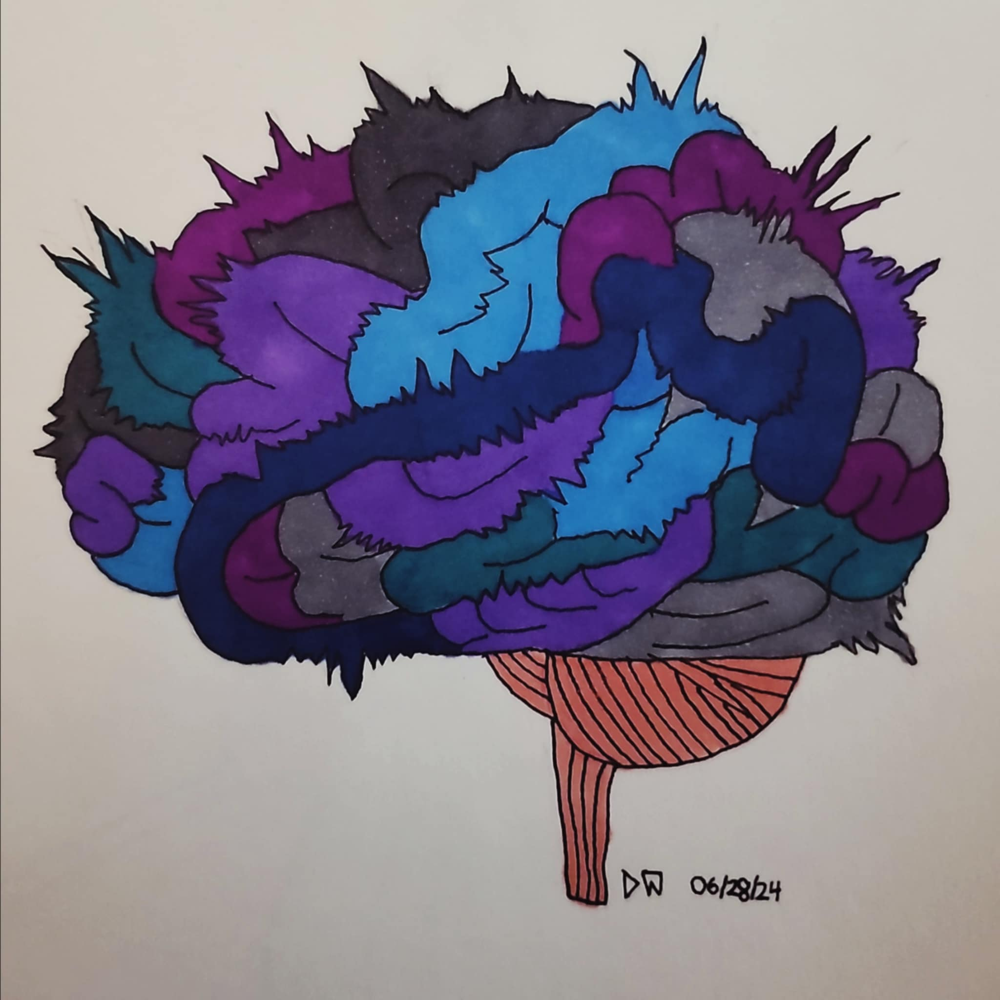

There are days when simply existing feels like an unspoken battle. The heaviness is not always visible—it does not scream or thrash—but it presses upon the body with quiet persistence, like an invisible tide pulling against every step. The philosopher Søren Kierkegaard once wrote, “Life can only be understood backwards; but it must be lived forwards.” To live forwards, however, often means bearing the weight of memory, expectation, and survival.
The Unseen Burden
Existence can feel like walking with stones sewn into the lining of our skin. Each stone carries a name: loss, trauma, loneliness, doubt. Some are inherited—passed down in silence through families who never speak of their wounds. Some are thrust upon us by circumstance, by injustice, by grief. And some we carve ourselves, chiseling self-doubt out of moments when we thought we should have been stronger.
Think of the mornings when getting out of bed feels like dragging your body through tar. The world calls it laziness. Psychology names it depression. But lived experience knows it as survival—the act of simply showing up when every part of you wants to vanish. As author Andrew Solomon observed in The Noonday Demon, depression is “the flaw in love,” the way our affection for life itself can break under the unbearable weight of its demands (Solomon 2001).
The Chains of Thought
The mind is both sanctuary and prison. Our thoughts replay old failures, binding us to ghosts of who we once were or who we should have been. “We are our own jailers,” wrote Virginia Woolf in A Room of One’s Own (1929), and for many, the bars are forged from whispers of inadequacy. In silence, we measure our worth against impossible standards, convinced that resilience means never faltering.
Yet survival is not about perfection. It is about continuing—limping, crawling, or stumbling forward through the storm.
Resilience in the Quiet
Even under the heaviest weight, there are flickers of light. A song that reaches us when words fail. A page in a book that seems to have been written just for us. A stranger’s smile that interrupts our spiral of thoughts. These moments are not grand victories; they are fragments of hope that remind us we are not alone.
Psychologist Viktor Frankl, in his seminal work Man’s Search for Meaning (1946), argued that survival is not merely about enduring suffering but about finding meaning within it. His experience in Nazi concentration camps revealed that even in the darkest circumstances, the human spirit clings to hope. “Those who have a ‘why’ to live,” he wrote, “can bear almost any ‘how.’”
A Testament to Being
To carry existence is to shoulder both its heaviness and its hidden grace. The exhaustion of being does not negate the quiet strength within us. The tears, the silence, the trembling hands—these are not failures but evidence of survival.
This is what Poetic Bipolar Mind embodies: a willingness to speak the unspeakable, to share the weight of existence so that no one must bear it alone. Here, the heaviness is laid bare—not to glorify pain, but to remind us that vulnerability is not weakness. It is the raw material from which resilience is forged.
Closing Reflection
Existence will always be heavy. But within that heaviness lies a truth: we endure, not because life is easy, but because within us is a quiet, persistent hope. And perhaps that hope—fragile as it seems—is the strongest weight we will ever carry.
Works Cited
- Frankl, Viktor E. Man’s Search for Meaning. Beacon Press, 1946.
- Kierkegaard, Søren. Journals and Papers. (Various editions).
- Solomon, Andrew. The Noonday Demon: An Atlas of Depression. Scribner, 2001.
- Woolf, Virginia. A Room of One’s Own. Hogarth Press, 1929.



Leave a Reply