Innovation & Health — Creative Hub
A drift through the 2020–2025 Dietary Guidelines — the why behind the guidance, the how behind every bite, and the plate I set for myself.
“The rationale behind the Dietary Guidelines is to encourage individuals to have healthy eating patterns in every stage of their life.”
The Rationale
The rationale behind the Dietary Guidelines is to encourage individuals to have healthy eating patterns in every stage of their life. It explains how people need to make changes in their eating habits as they progress through the stages of life. These various guidelines were developed so that individuals would have direction in what the right choices are to meet their nutritional needs, achieve a healthy body weight, and to reduce the risk of chronic diseases.
Every five years, the U.S. Departments of Agriculture and Health and Human Services rebuild this guidance from the current body of nutrition science, and the 2020–2025 edition states its purpose plainly: the Guidelines exist to “provide advice on what to eat and drink to meet nutrient needs, promote health, and prevent disease” (U.S. Department of Agriculture & U.S. Department of Health and Human Services, 2020). That is the whole rationale in one sentence — not a diet, not a trend, but a map redrawn each half-decade so that an infant, a teenager, an expectant mother, and an elder are each eating for the body they actually have, in the season of life they are actually in.
The Three Recommendations
01 — A healthy dietary pattern at every stage of life. A specific recommendation outlined in the 2020-2025 Dietary Guidelines is to follow a healthy dietary pattern according to the individual’s stage in life. A healthy dietary pattern includes consuming foods in all food groups that are nutrient-dense in the recommended amounts and within a person’s calorie limits. “Nutrient-dense” is the Guidelines’ quiet keyword: foods that carry a high cargo of vitamins, minerals, and fiber for the calories they cost — leafy greens over iceberg, whole grains over refined, beans and lentils alongside lean proteins. In a grocery cart, it looks like color. In a week, it looks like variety. The pattern matters more than any single meal.
02 — Limit added sugars. Another recommendation in the Guidelines is to keep added sugars low — the 2020–2025 edition sets the limit at less than 10 percent of daily calories, which is about 200 calories, or 50 grams, on a 2,000-calorie day. The sugars that count are the ones added in processing and preparation, not the sugars native to fruit or milk: the sweetener hiding in a bottled tea, a flavored yogurt, a “healthy” granola. The companion limits travel with it — saturated fat under 10 percent of calories, and sodium under 2,300 milligrams a day.
03 — Human milk first. A third recommendation is to feed infants younger than six months human milk, but if that is unavailable, they should be fed iron fortified infant formula. The Guidelines open at the very beginning of life: exclusive human milk for about the first six months, continued alongside complementary foods through the first year and beyond, with vitamin D supplementation in the early months and iron-rich first foods — fortified cereals, meats, beans — arriving around six months, when an infant’s own stores begin to run low. The rationale from Recommendation 01 starts here, at the smallest table of all.
Reading the Label
The information a person should be looking for on nutrition labels to help them decide if a product is a healthy choice are the calories, the added sugars and sodium sections. This information is important to look at before consuming so that the person can keep track of their intake of calories, added sugars, and sodium levels in a day. If they are going to exceed the recommended amount, they can make the informed decision to not consume the product.
Watch how fast the arithmetic happens in practice. A single flavored coffee drink can carry 45 grams of added sugar — nearly the entire day’s 50-gram budget before breakfast is over. A canned soup that looks modest at 890 milligrams of sodium per serving quietly holds two servings in the can: 1,780 milligrams, more than three-quarters of the day’s 2,300, in one bowl. The label is not fine print meant to shame anyone. Read the way the Guidelines intend, it is simply a receipt written in advance — a chance to decide before the fact instead of after it.
MyPlate: The Guidelines in Full Color
It makes the Guidelines easier to understand for individuals, families, and communities. MyPlate was developed so the public could be more aware and informed about healthy foods and drink choices. I would utilize MyPlate in planning meals by following the recommended 2,200 calorie a day plan it suggested to me. The MyPlate tool also provided a list of the amounts of foods I should consume based on the food groups; I would use this chart in my meal planning to make sure I am following a balanced nutrient-based meal each time.
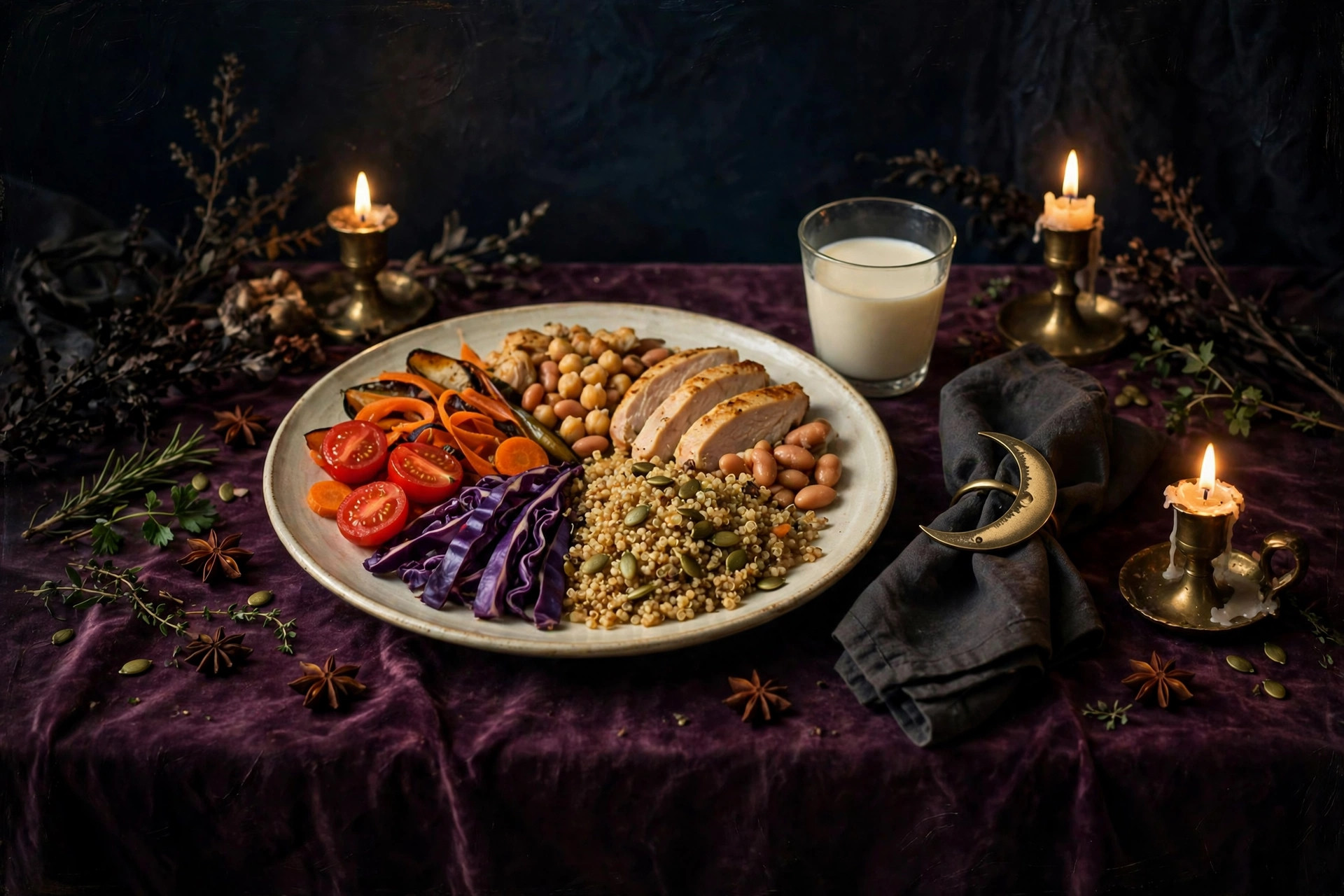
MyPlate’s own instruction is disarmingly simple: “Make half your plate fruits and vegetables.” One half of the plate goes to fruits and vegetables; the other half is shared by grains and protein; a serving of dairy sits beside it, like a small moon next to the main planet. A nine-inch circle ends up teaching what 140 pages of guidance argue — proportion. No weighing, no app required at the table itself: just a plate, divided honestly.
“Most Americans do not follow the Dietary Guidelines.”
The Gap
Most Americans do not follow the Dietary Guidelines. According to the Dietary Guideline 2020-2025 (pg. 26), the Healthy Eating Index took measure of diet quality, and the intakes are not consistent with the Guidelines. This is due to Americans increasingly consuming calorie imbalanced meals and low physical activity.
The numbers behind that sentence are stark. The average American diet scores about 59 out of 100 on the Healthy Eating Index — a passing grade in no classroom. Roughly 74 percent of adults are living with overweight or obesity, and about six in ten adults live with at least one chronic disease — heart disease, diabetes, conditions the Guidelines were written, in large part, to prevent. The gap is not a failure of information alone; the guidance exists, free, in full color. It is a failure of translation — of turning a federal document into Tuesday’s dinner. Which is, in the end, what tools like MyPlate, and essays like this one, are for.
Feeding the Whole Life
There is a reason a document about food keeps using the word pattern. A pattern is not a single choice; it is a rhythm — the thing you return to, the shape your ordinary days make. Anyone who keeps a creative life knows that rhythm from the other side of the table. Pages are not written in one heroic sitting; they accumulate, line by honest line, on days when sitting down felt easy and days when it didn’t. A body is kept the same way. No single meal ruins or redeems anyone, just as no single sentence makes a book. What matters is the pattern you can actually live inside — meals that steady your energy instead of spiking it, food that leaves the mind clear enough to do its own work, small rituals of nourishment repeated until they hold. The Guidelines, read generously, are not a scolding. They are an argument that the person doing the living deserves to be fed like the work matters — because it does.
My Own Table
After having reviewed these guidelines, they change my nutritional choices greatly. I noticed that I was not having balanced meals and wasn’t well informed on what nutrient-dense foods were. Now that I have this knowledge, I have become more conscious on the foods that I am putting into my body and am trying to keep a daily calorie count. I am using the charts that MyPlate provided me after inputting my information into the tool as well.
And that, ultimately, is the rationale working as intended: not a rulebook memorized, but a way of seeing — the label read before the purchase, the plate divided before the meal, the pattern noticed before it hardens. The Guidelines hand us the why. The table is where we answer with the how.
Works Cited
U.S. Department of Agriculture and U.S. Department of Health and Human Services. Dietary Guidelines for Americans, 2020–2025. 9th ed., December 2020. DietaryGuidelines.gov.
U.S. Department of Agriculture. “MyPlate.” MyPlate.gov. Accessed 2024.
Poetic Bipolar Mind



Leave a Reply