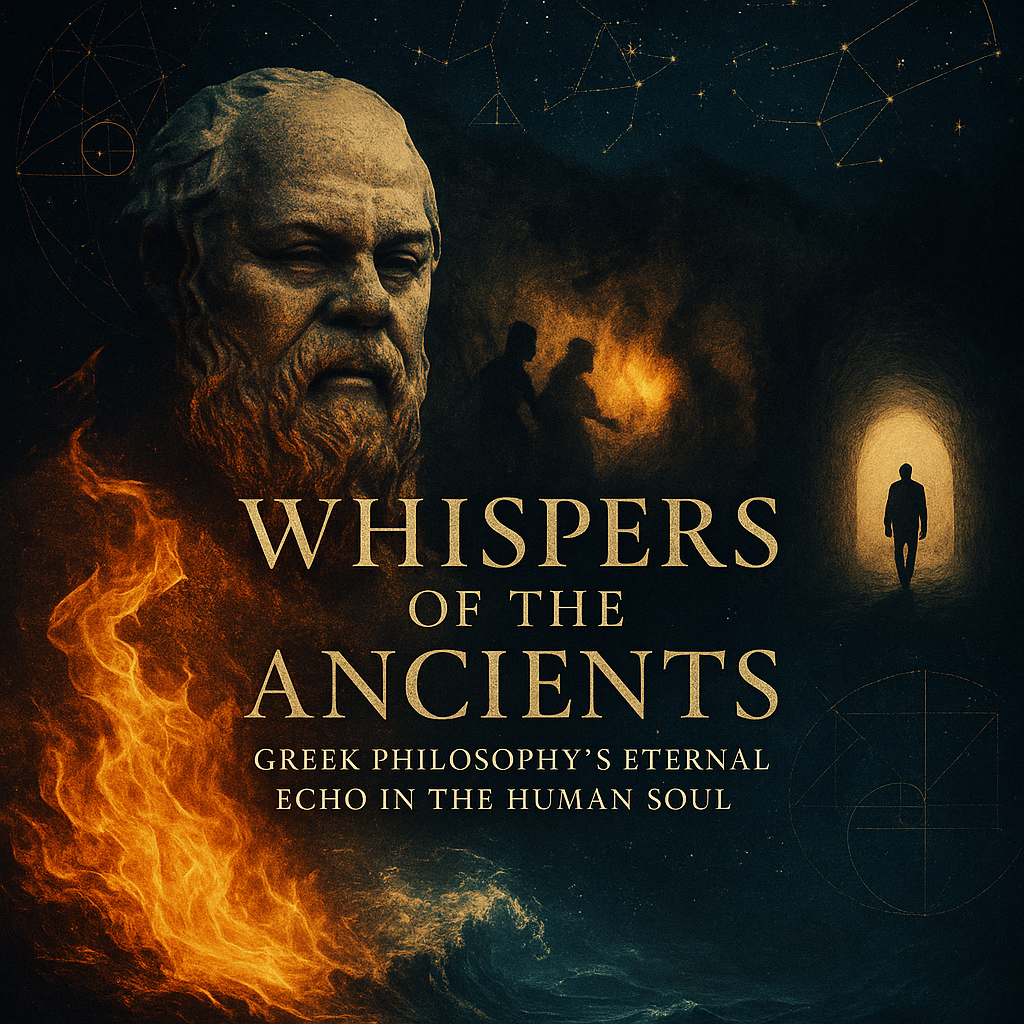
Greek Philosophy’s Eternal Echo in the Human Soul
When we look back at the ancient world, it is easy to imagine philosophy as something abstract, reserved for marble halls, libraries of papyrus, and stone busts carved in solemn profile. Yet Greek philosophy was never just theory—it was survival, longing, and the unrelenting pursuit of truth. It was born from myth, tested by reason, and sustained by the human need to make sense of suffering and joy alike.
Before the philosophers walked the earth, poets sang. Homer, Hesiod, and others wove myths that offered answers to questions too large for mortal minds: Where do we come from? Why do we suffer? What holds the universe together? Their stories were not only entertainment—they were maps. Myths reminded people of virtues like courage and warned of ruinous flaws like hubris. They gave language to the unfamiliar by drawing on the familiar. As Joseph Campbell reminds us, myths are not lies, but metaphors pointing to truths that reason had not yet learned to articulate.
Chapter I · The First PrincipleThales of Miletus
Then came Thales of Miletus, who dared to ask: What if the world could be explained not only in story, but in principle? He chose water as the source of all things: flowing, life-giving, ever-shifting. From that single step, philosophy was born—not to replace poetry, but to walk alongside it.
Chapter II · The BoundlessAnaximander & Anaximenes
Thales and his successors in Miletus—Anaximander and Anaximenes—began to peel back layers of myth with rational inquiry. Anaximander spoke of the Apeiron, the Boundless, an infinite source beyond form. Anaximenes turned to air, the breath of life, compressing and expanding, showing that reality was not only infinite but dynamic. Already the Greeks were confronting paradox: permanence and change, being and becoming, form and formlessness.
Chapter III · HarmonyPythagoras
And then there was Pythagoras, who looked to numbers not merely as measures but as the music of the universe. He taught that purification of the soul was salvation, that harmony—whether in mathematics or in music—revealed the structure of the cosmos. His vision reminds me of how healing often comes through rhythm: the heartbeat, the cadence of words, the rise and fall of grief like a song you cannot silence.
Chapter IV · FireHeraclitus
Heraclitus, the “lover of paradoxes,” insisted that fire is the essence of reality—always consuming, always renewing. “This world-order, the same for all, none of the gods nor of men has made … an ever-living fire” (Heraclitus, Fragment 30). Fire, to him, was the paradox of destruction and creation entwined. His insight carries into our lives: conflict, though painful, is the very engine of growth.
“This world-order, the same for all, none of the gods nor of men has made … an ever-living fire”
— Heraclitus, Fragment 30
Chapter V · StillnessParmenides & Zeno
Parmenides countered with a radical claim: change itself is an illusion. Whatever is, simply is. To him, reality was one, indivisible, unchanging. Zeno defended this with paradoxes that still puzzle us today. Here lies another lesson: what seems obvious to the senses may crumble under the weight of logic.
Chapter VI · The Human QuestionSocrates
Socrates later gave these questions a human face. For him, philosophy was not about abstract systems but about how to live. He reminded us that “the unexamined life is not worth living” (Apology 38a). He taught that ignorance was not weakness but disease, and knowledge was its cure. Yet his courage to question power cost him his life. His trial and death remind me that truth often demands sacrifice—and that to live honestly sometimes means to live dangerously.
“the unexamined life is not worth living”
— Socrates, Apology 38a
Chapter VII · Light & PurposePlato & Aristotle
Plato, his student, gave us the allegory of the cave, reminding us that many of us are chained in shadows, mistaking illusions for reality. Only through struggle and light can we see truth. And Aristotle, ever the biologist of the soul, insisted on four causes, reminding us that purpose (the final cause) is what makes life meaningful. For him, happiness (eudaimonia) was not pleasure but fulfillment of human nature through virtue.
The Eternal Echo
The Greek legacy, then, is not only the birth of reason—it is the persistence of wonder. Their questions echo into our own lives: What is the essence of being? How do we find justice? What does it mean to live well?
For me, and for Poetic Bipolar Mind, these questions are not abstract. They resonate in my struggles with grief, identity, and silence. I see myself in Xenophanes’ rejection of gods made in human image, in Plato’s longing for truth beyond shadows, in Heraclitus’ fire that destroys yet illuminates. These voices remind me that the battle between despair and hope, chaos and harmony, ignorance and wisdom is an ancient one—that I am not alone in it.
Greek philosophy’s lasting gift is not certainty. It is courage: the courage to ask, to doubt, to sit in paradox. It is the reminder that to be human is to be both lost and searching, fragile yet unyielding, mortal yet dreaming of immortality. And in that eternal echo, perhaps, lies our truest kinship with the ancients.
Works Cited
- Adler, Mortimer Jerome, and ADLER. Aristotle for Everybody: Difficult Thought Made Easy. New York, Simon & Schuster Adult Publishing Group, 1997.
- Connole, Joseph. “Plato and Aristotle’s Regimes: Republic and Politics.” Formatia Trans Sicere Educatorum, Federalist Publicola, 15 Oct. 2007.
- Heraclitus. Fragment 30. In The Presocratic Philosophers, edited by G.S. Kirk, J.E. Raven, and M. Schofield. Cambridge University Press, 1983.
- Lawhead, William F. The Ancient Voyage: The Greeks and Romans. 2nd ed., Wadsworth Publishing, 2001.
- Linder, Doug. “The Trial of Socrates: An Account.” Famous Trials Project, University of Missouri-Kansas City School of Law. http://law2.umkc.edu/faculty/projects/ftrials/socrates/socratesaccount.html. Accessed 22 Feb. 2017.
- Merriam-Webster. “Knowledge.” 2016. https://www.merriam-webster.com/dictionary/knowledge. Accessed 12 Dec. 2016.
- Vanier, Jean. Made for Happiness: Discovering the Meaning of Life with Aristotle. House of Anasi Press, 2012.
- Zachary, Gilbert. “Aristotle 384 – 322 BC.” Philosophy 101. SUNY Westchester Community College, New York. Nov. 2016.
- Zachary, Gilbert. “Socrates vs The Sophists and The Citizens of Athens (The Death Knell of the Athenian Republic).” Philosophy 101. SUNY Westchester Community College, New York. Oct. 2016.

Leave a Reply