The river does not rush me.
It never has.
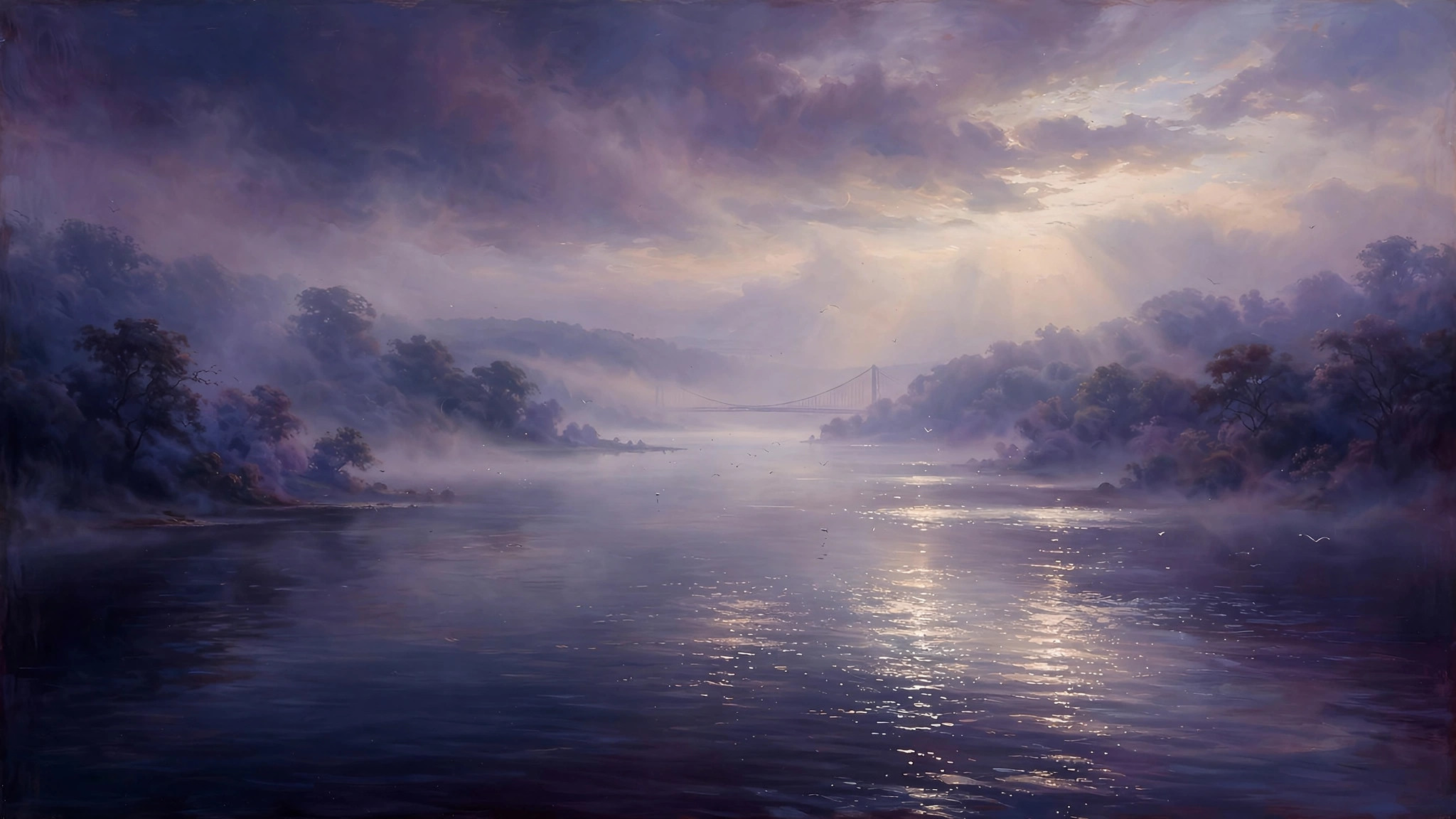
On mornings when fog drapes itself across the Hudson, the world feels unfinished—edges softened, distances uncertain. I stand there anyway, breathing in air that smells faintly of water and iron, watching the current move with a patience grief understands. The river does not demand clarity. It allows things to remain half-seen.
For a long time, I believed healing required certainty. I imagined recovery as a destination with visible landmarks, a place where every question found an answer and every wound became a scar without tenderness. The Hudson has taught me otherwise. It moves with quiet confidence, unconcerned with arriving quickly. Its strength lies not in haste but in constancy.
Grief, I have learned, behaves much like the tide. Some days it recedes far enough to uncover forgotten ground—old laughter, familiar voices, fragments of myself I believed had disappeared beneath years of sorrow. On other days it returns without warning, reclaiming emotional shorelines I thought I had already crossed. Neither movement is failure. Both are part of the same living rhythm.
Standing beside the river, I notice how effortlessly it accepts contradiction. Calm water can conceal powerful currents beneath. Morning fog eventually yields to brilliant sunlight. Winter ice gives way to spring melt without argument or ceremony. Nature never apologizes for changing. It simply continues.
Perhaps people deserve the same permission.
The bridges stretching across the Hudson have become quiet teachers. They never erase the river below them. They acknowledge its presence, honoring both distance and connection. Every crossing reminds me that healing does not require leaving pain behind. Instead, it asks us to build ways of living alongside it.
Some mornings I come without intention. I simply walk. My footsteps follow the shoreline while gulls circle overhead and wind presses gently against my coat. The river speaks through smaller languages than words—the soft percussion of waves against stone, reeds bending with invisible currents, sunlight breaking into fractured silver across the surface. These moments ask nothing of me except attention.
There is comfort in being witnessed by something that expects nothing in return.
Modern life often mistakes healing for productivity. We measure progress in milestones, accomplishments, and visible transformations. Yet the river keeps no ledger. It does not congratulate itself for continuing to flow. It simply exists, faithful to its own nature.
Watching it has changed the questions I ask myself.
Instead of wondering whether I am “better,” I wonder whether I have remained open.
Instead of asking whether grief has ended, I ask what it has taught me today.
Instead of searching for closure, I look for presence.
The Hudson has become less a place than a companion. It receives every version of me—the hopeful one, the exhausted one, the angry one, the grateful one—with the same quiet acceptance. It never insists I arrive polished or complete. It asks only that I arrive honestly.
That honesty has become its greatest gift.
There are still mornings when memory arrives heavier than the mist rising from the water. There are afternoons when silence feels too large to carry alone. But the river has shown me that silence need not be empty. Sometimes it is simply another form of listening.
Perhaps healing has never been about becoming someone new.
Perhaps it is about returning, again and again, to the places that remind us we have survived.
The Hudson does not promise easy answers.
It offers something quieter.
Something steadier.
Something that asks nothing except that I keep showing up.
The Hudson does not cure me.
It witnesses me.
And sometimes, that is enough.
← Back to the series introduction: The Hudson as Healer — A Series Introduction · Next: Low Tide Lessons →


Leave a Reply