Where the Waters Flow:
A Reflection on Water’s Journey Through Sleepy Hollow and Beyond
By Kiana Jimenez | Poetic Bipolar Mind
Water is more than a resource. It is a memory, a motion, a rhythm that moves through the world as quietly as breath and as powerfully as thunder. It exists in every corner of our lives—sometimes invisible, sometimes loud, always essential.
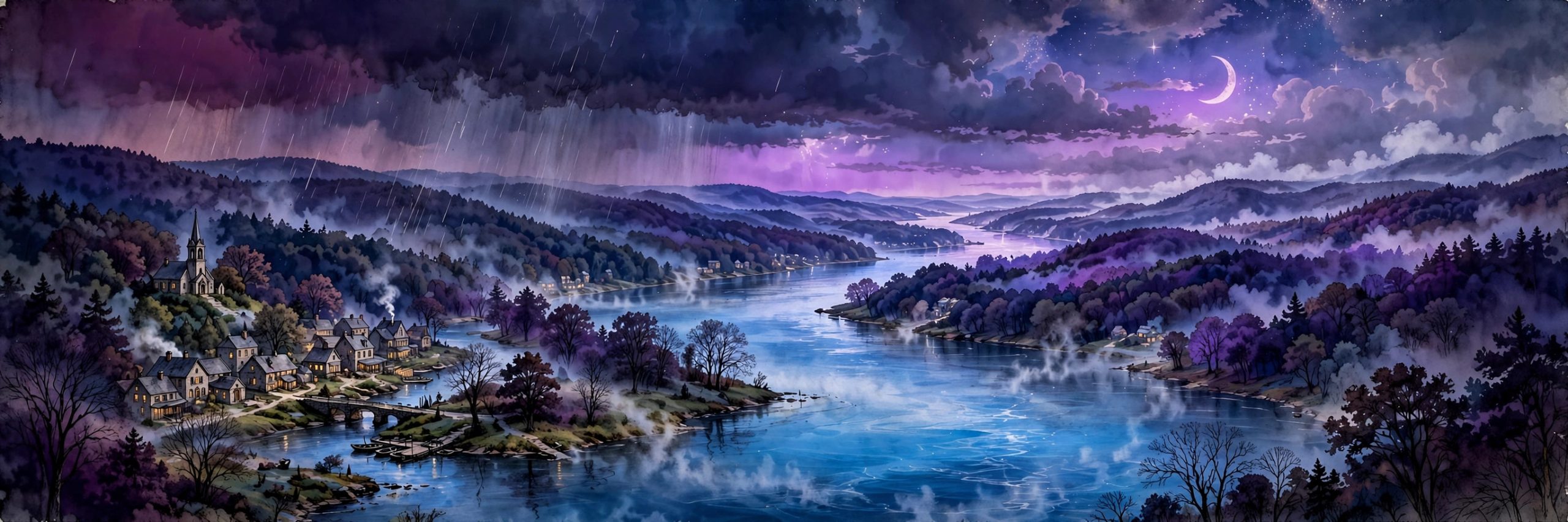
Living in Sleepy Hollow, a village cradled between the mighty Catskill Mountains and the Hudson River, I’m surrounded by water’s graceful presence every day. It flows not just through pipes and faucets—but through forests, rivers, and clouds. In this post, I reflect on how water moves through my environment, how it transforms, and how it compares to an entirely different world: the Mojave Desert.
🌊 Water in Sleepy Hollow: A Living Landscape
In my home environment, water lives and breathes in liquid form. The Hudson River, a tidal estuary stretching over 300 miles, flows from Lake Tear of the Clouds in the Adirondack Mountains down through the Hudson Valley until it merges with the Atlantic Ocean at New York Harbor. This majestic river runs north to south, carrying with it history, life, and transformation.
Within my home, water courses through everyday life: from the kitchen tap to the shower head, from rainy windows to snow-dusted rooftops in winter. It is stored in underground aquifers, drawn into homes through municipal systems, and released again—cycled and purified, endlessly reused.
But water is more than what we drink. It shapeshifts, obeying the rhythms of the hydrologic cycle. When the sun shines, liquid water evaporates from rivers, lakes, and even pavement—rising as invisible water vapor. Higher in the sky, the air cools, causing vapor to condense into droplets that form clouds. When these droplets grow heavy, they fall as precipitation—rain, snow, or sleet—returning again to earth, beginning the cycle anew.
This movement is poetry in motion—water as traveler, transforming yet eternal.
🏜️ The Mojave Desert: A Stark Contrast
To understand water’s behavior more fully, I turn to a place nearly opposite my own: the Mojave Desert. Spanning across California, Nevada, Arizona, and Utah, this environment tells a very different water story.
In the Mojave, water is scarce. Rainfall is minimal—averaging less than 5 inches annually. Rivers are rare, often dry. Lakes appear only after rare storms, and even then, they evaporate quickly under scorching sun. The desert sky holds little moisture. Why?
Because the Mojave is shaped by extreme heat, high atmospheric pressure, and arid conditions. These factors prevent moisture from rising, which means clouds don’t form easily, and rain becomes an infrequent visitor. Without regular precipitation, the land becomes parched and cracked, forcing plants and animals to adapt in extraordinary ways—like storing water for months, or blooming only after rare rainfall events.
While Sleepy Hollow is nurtured by an abundance of flowing rivers and rainfall, the Mojave survives in thirst and resilience.
🌦️ The Forces That Shape Water’s Journey
So what causes these drastic differences between my lush valley and the arid expanse of the Mojave?
It all comes down to climate and geography:
- Sleepy Hollow is located in a temperate region with four seasons, where precipitation is regular and the landscape includes rivers, forests, and mountains. This geography helps trap and move moisture, feeding an abundant hydrologic cycle.
- The Mojave Desert exists in a rain shadow, shielded by mountain ranges that block incoming moisture. Its dry, hot air suppresses cloud formation, leading to prolonged droughts and extreme water scarcity.
Where I live, water flows freely. In the desert, it must be chased.
💭 Final Reflection: Water as Memory and Meaning
As I sit near the Hudson River, I often reflect on how water connects everything—from the mountain streams of the Adirondacks to the salt-kissed edges of the Atlantic. It is the same water that once nourished Indigenous lands, powered colonial industry, and now sustains families in villages like mine.
But water is also a mirror—of place, of people, of priorities. In Sleepy Hollow, we may take its abundance for granted. In the Mojave, it is revered. Perhaps we need both perspectives: to honor what we have, and to understand what others must endure.
Because in the end, water is more than chemistry. It is life, shaped by land and climate, yet carrying the stories of every place it touches.
📚 Works Cited
- United States Geological Survey (USGS). “The Water Cycle.” USGS Water Science School, www.usgs.gov/special-topic/water-science-school/science/water-cycle.
- National Park Service. “Mojave Desert Ecosystem.” U.S. Department of the Interior, www.nps.gov/moja/learn/nature/ecosystems.htm.
- New York State Department of Environmental Conservation. “Hudson River Estuary Program.” www.dec.ny.gov/lands/4920.html.
- National Oceanic and Atmospheric Administration (NOAA). “Precipitation Patterns and Climate Zones.” www.climate.gov.



Leave a Reply